
A review of the Milton/Foley debate
In late 1997 and early 1998, Richard Milton and I (Jim Foley) debated the topic of human evolution on a small mailing list. Because we were continually including previously quoted material, the text of the debate is quite voluminous and repetitive. This article attempts to serve as a summary and guide to the debate, with links to the original material being referred to. I have tried to make this summary as accurate as possible, and I will make corrections and clarifications where necessary.The original debate
- 1. Foley to Milton (Aug 15, 1997) 6K
- 2. Milton to Foley (Aug 17, 1997) 13K
- 3. Foley to Milton (Aug 26, 1997) 20K,
(summary Sep 24, 1997)
- 4. Milton to Foley (Oct 10, 1997) 49K,
(summary Oct 08, 1997)
At this point, the messages were getting so long that Jim Foley's reply to the last message was broken into 4 sections.
- 5a1. Foley to Milton (Java Man) (Oct 22, 1997) 13K
- 5a2. Milton to Foley (Java Man) (Dec 7, 1997) 28K
- 5a3. Foley to Milton (Java Man) (Feb 3, 1998) 36K
- 5b1. Foley to Milton (Homo habilis) (Nov 5, 1997) 19K
- 5c1. Foley to Milton (Australopithecines) (Dec 2, 1997) 12K
- 5d1. Foley to Milton (misc) (Dec 4, 1997) 25K
The rest of this webpage contains material from the debate, broken into topics.
Note that throughout this debate, Milton almost never supplies references for his claims. To avoid my having to say something like "Milton supplied no reference for this claim" hundreds of times, you can take it as a given except on the rare occasions when he did supply a reference, in which case I will discus that reference.
Java Man
The debate started off with me disputing Milton's claims that"'Java Man' is now accepted as having been an extinct ape" *and
"FACT: Java 'man' was a gibbon (see any competent authority)". *I disputed these in my first message, pointing out that all modern authorities (I listed 9 of them) accept Java Man as belonging to Homo erectus, and asked which authorities he had in mind. *
Milton claims support from Reader (1981) *. Milton raises the red herring of the femur Dubois found near the Java Man skullcap, apparently believing that anyone who considers Java Man to be not a modern human is associating the femur with the skullcap and therefore incompetent. However, my statement that the skullcap was H. erectus, and that all modern scientific authorities consider it so, was made without any consideration of the femur. Milton half-admitted that he didn't have any basis for his original assertion by backpedalling away from it slightly, this time saying: "It is my understanding ...", instead of making a flat assertion.
I predicted (having not yet read Reader's book) that Reader supports my contention that the Java Man skullcap is Homo erectus, asked once again for any scientists who supported his claim that the skullcap belonged to a gibbon, and pointed out neither I nor the other scientists attributing Java Man to Homo erectus were claiming that the skullcap and femur belonged together *.
Richard asserted that Reader does support his claim that Java Man was an ape-like skullcap *. Having now read Reader's book, I pointed out that, as I had predicted, Reader does not say that Java Man was an ape, and in fact shows that it was not an ape, and why *:
"The new specimens [found in Java in the 1930s] matched what there was of Dubois's fossils [i.e. Java Man] and supplied enough of what was missing to satisfy everyone that the Java and Peking fossils all represented an early form of man, with almost nothing of the ape about him" (Reader, p.46).It takes some serious doublethink to claim this as support for the idea that Java Man skullcap belonged to an ape.
Milton evades this by claiming that this quote refers to the discovery of later skeletons *. Which it does, but it also clearly states that these new discoveries showed Java Man was not an ape, evidence which Milton ignores.
To further support his statement that Java Man is now accepted as an extinct ape, Milton cited three authorities, from 1895, 1923, and 1935 *. The absurdity of using 101, 74 and 62 year-old quotes to support a claim about modern-day opinions seems not to strike him.
The first of these quotes, from Rudolf Virchow, was made in 1896 and asserted, based on anatomical reasons, that the skull cap was from a giant gibbon *. I responded that this assessment was over a century old and based on a single fossil *. Milton responded at some length, arguing that time had not invalidated Virchow's anatomical conclusions, that Virchow had shown the skullcap to have an anatomical feature found only in apes, and that I rejected Virchow's conclusions because they contradicted "my Darwinist beliefs" *.
In response, I pointed out that while anatomy of living creatures has not changed, it is better known now and our knowledge of the fossil record is far better *.
As for Virchow's supposedly conclusive anatomical feature, Virchow's opinion was only one of many circulating even when he made it, and it is ridiculous to believe that no further study or fossil finds could possibly overturn it. Indeed, this is exactly what happened: later finds of skulls similar to the original Java Man showed that it definitely did not belong to a giant gibbon. Virchow's argument was logically weak even before that, as there's no reason an ape/human intermediate might not contain features previously found only in apes *. In fact, it was soon shown that Virchow's diagnostic feature was found in humans:
"Finally, Virchow asserted that the deep notch between the orbital edges and the low skullcap of Pithecanthropus - a sign of a very deep confirmation of the temporal fossa - were decisive for the ape-like character of the skull, and that such a formation never occurs in man. A few weeks later, Nehring ... showed that exactly the same formation was presented by a human skull from Santos in Brazil. (Shipman 2001, p.344)Finally, Milton claimed that I rejected Virchow's claim because they contradicted "my Darwinist beliefs". This is breathtaking in its hypocrisy. I rejected one obsolete opinion for reasons that are well documented in modern books. Milton has rejected the opinion of every qualified scientist in the last 60+ years, for no apparent reason other than that they contradict what he wishes to believe *.
Milton's second quote comes from Marcellin Boule's 1923 book Fossil Men where he said that "the skullcap resembled that of an ape, possibly a large gibbon". If this was indeed Boule's conclusion, he clearly changed his mind later. The 1952 edition of Boule's book is emphatic in its recognition of Java Man as an ape-human intermediate, as I documented *. Milton claimed to have a response to this but, for reasons of brevity, declined to respond immediately *. I accepted his invitation to respond, but he never did (I think he was bluffing) *.
CONTINUE HERE
Dubois quote...
When I mentioned the similarity between Java Man and the Turkana Boy Homo erectus skeleton (5a1), and even gave the web address of a picture showing the similarity, Milton objected to comparisons of Java Man with any other skull, claiming (message 5a2) that Java Man can only be evaluated "by reference to the anatomy and geology of the skullcap itself". This argument is ridiculous, as well as hypocritical: Milton himself uses comparisons made by scientists between Java Man and apes (though only when they suit his conclusions, of course). How can any fossil be evaluated except by comparing it to other fossils and living animals?
When Milton suggests that the Java Man skullcap might be that of a large gorilla skull, he feels this is perfectly plausible and needs no justification even though they differ in brain size and many other anatomical features. And yet when I suggest that the skullcap is similar to the Turkana Boy skull belonging to Homo erectus, and link to pictures of both skulls for comparison, and invite him to compare them, that is a "wild surmise". Note that, in the excitement of his indignation about my "wild surmise", Milton avoided answering my question about the skulls, refusing either to confirm their similarity (which would have conceded my point) or deny it (which would be obviously false).
Milton claims that the Java Man skullcap is "a tiny fraction of the skull", either "about 10 per cent" complete, or between 10 and 20 percent complete; too small to reliably measure its brain size. This is just mindboggling. The Java Man fossil is one of the most famous in the world, and photos of it are found in most books on human evolution, and yet Milton seems to be unaware what it looks like. I would estimate that about 40% of the complete skull was recovered, and over half of the brain case. But check for yourself; do you think the original skull would have contained 5 to 10 times as much material as the fossil?
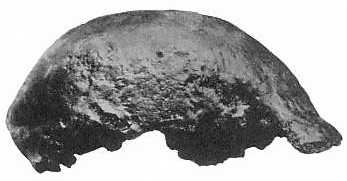
Milton is actually making two different claims about the Java Man skullcap. The first is that competent authorities believe that it belongs to a gibbon ["FACT: Java "man" was a gibbon (see any competent authority)"]. The second is that it really does belong to a gibbon. Both statements are hopelessly, wildly, wrong. You can verify for yourself that the first one is wrong by going to a library, looking through a few books on human evolution, and trying to find one that agrees with Milton. I guarantee you won't (outside of creationist literature).
Think about this for a moment. According to the blurb in his book, Milton had been interested in evolution and writing on science and technology for over 20 years. And yet, he had no idea how scientists classify one of the most famous hominid fossils ever discovered. Milton's 20 years of research must have been remarkably selective.
Java Man at the AMNH
Attempting to show that Java Man is discredited, Milton states (message 2) that Java Man was removed from display in the American Museum of Natural History. I asked (message 3) for supporting evidence. Milton's statement seemed highly unlikely, given that Java Man figures prominently in books by Ian Tattersall, curator of the AMNH's human evolution exhibit. Milton, clearly confident that his claim is correct, asks (message 4) "where precisely" the Java Man fossils can be found in the AMNH. Message 5a1: I produced an email from Ian Tattersall of the AMNH confirming that Java Man was indeed exhibited in the museum. Message 5a2: Milton actually conceded defeat on this point (the only time he did so in the entire debate).Milton announced his intention to write to the AMNH to "ensure that this bogus fossil is correctly labelled as that of an apelike creature". I hope he did so; it could have gone on the canteen wall there to give everyone a good laugh.
The Leiden Reconstruction
Milton once referred to an early Java Man reconstruction at the Leiden Museum (sculpted by Eugene Dubois) which had later been withdrawn from display:It was in recognition of these facts [the unverified associated between the skullcap and femur] that the restoration of Java 'man' paid for by Ernst Haeckel was removed from the Leiden Museum to its basement ..." (msg2)I did not know anything about this reconstruction but, unlike Milton's other claims about Java Man, I had no reason to doubt that it was true. Because I was curious, I asked him about it, taking pains to phrase my request in such a way as to indicate that I was not challenging his statement, but merely requesting further information about it:
"I don't know anything about the Leiden reconstruction or why it might have been removed. Any references on this?" (msg3)
Milton responded that:
I've already given you the reference to this. See John Reader, 'Missing Links', 1981. If you consult it you will see the photograph of "Java Man" standing forlornly in the basement on page 53.Milton was clearly trying to score a point here by implying that he'd already given the reference and I wasn't paying attention. However, there was no indication in the debate so far that this particular information came from Reader's book.
Nevertheless, I accepted that the reference did indeed show what was claimed, but that it didn't prove the other statements Milton had been making about Java Man being a gibbon:
So he is. Doesn't mean Java Man is a gibbon, of course. As Reader points out, Java Man is now thought to be more human-like than Dubois' reconstruction, not less. (msg 5a1)
All through the debate, Milton had been evading requests to back up his claims with references. Now that he has finally been able to do so for one inconsequential statement, he is full of bravado and trumpets it as a victory (5a2):
This is an example of Foleyism that I shall treasure and will certainly quote in my next book, if Jim will give his permission. First Jim challenges my statement: it seems to him improbable. I prove my statement with uncontestable evidence, so Jim shifts his ground. OK so my statement is true, but now it is suddenly unimportant.It was Arthur C Clarke who said that there are four stages in the acceptance of any new scientific idea.
1. It's nonsense.
2. OK it's true, but it's unimportant.
3. I always said it was important.
4. I thought of it first.I look forward to the day when Jim claims, on talk.origins, that it was _he_ who first expressed doubts about neo-Darwinism, despite the barbaric and ill-informed attacks by people like Richard Milton.
Comparing reality with Milton's bombast, one can see that I never challenged his statement, or said that it was "improbable" or "suddenly unimportant" (it was always unimportant).
Also, it's interesting to note that Milton is quite capable of promptly supplying a reference when he actually has one. It would seem to imply that all his other evasions when asked for references are a deliberate strategy used when he doesn't have a reference, knows he doesn't have a reference, and doesn't intend to admit it and would like to distract attention away from these inconvenient facts.
Homo habilis
Milton originally said that "Homo means human", and that Homo habilis was "not significantly different from living humans". Disputed in my first message. Message 2: Milton reasserts that there is nothing to distinguish Homo habilis from modern humans, and claims, twice, that Mbuti pygmies are of comparable size and brain capacity to H. habilis. No supporting data is provided for these statements. Message 3: I gave numerous quotes from modern experts which show differences between H. sapiens and H. habilis, and also figures showing that the brain sizes of the two species have almost no overlap. Once again, I asked Milton for support about his claim. Message 4: Milton ignores the cited differences, and repeats his assertion that H. habilis has no significant differences from some modern humans. (References to Huxley and Davies) Once again, he claims that Mbuti pygmies have comparable brain size and height to H. habilis, and once again he fails to provide any evidence for it, in spite of the fact that I specifically asked for it. Milton also made the same claims in a summary of his message 4, and even said: "I give figures that show that Jim is mistaken and that the cranial capacity of some modern humans is in the same range as H. habilis". This statement is blatantly false, and no figures, references or anything else were provided to support his claim. Milton, citing my own webpage which shows that H. habilis and H. sapiens have almost totally non-overlapping brain size ranges, tries to twist it to support his statements about habilis brain sizes. I particularly marvelled at the cheek with which Milton accused my documented figures of being biased, even though he never supplied any of his own.Message 5b1: I disputed all of Milton's claims about H. habilis (with considerable documentation), pointed out once again that Milton had failed to provide references for his claims about Pygmy brain sizes (or anything else), and, once again, asked Milton for evidence for his claims. Milton made no further response.
Although Milton never provided any references to support his claims about habilis, his book references A. J. Monty White. So why didn't Milton provide me that reference during the debate, since it was clearly where he got the claim from? Probably because it was apparent even to him that the reference was blatantly inadequate. White has no expertise in human evolution and himself provides no references in support of his claim. Milton clearly realized that the White reference was inadequate, and that he didn't have a leg to stand on. And yet, that didn't stop him trying to bluff his way through by continuing to make a claim even though he knew he had no evidence for it.
Mbuti Pygmies
I'm saying that there are modern humans, living only a few miles from the place where these fossils were found, who have comparable stature and brain capacity to habilines (the Mbuti pygmies of Zaire).
One of the ironic aspects of the discovery of Homo habilis is that while Darwinists concentrate their attention on interpreting the fossils from Olduvai Gorge, attempting to establish the creature's credentials as a missing link, they appear to have overlooked the fact that only a few miles to the east, in the forests of Zaire are the Mbuti people who are on average only four foot to four foot six inches tall and who, in stature, brain capacity, and even way of life, are comparable to Homo habilis. Yet the Mbuti people are modern men in every sense.
I said that there are modern humans that are comparable with H. habilis in stature, brain capacity and way of life. I have cited one example of modern humans (the Mbuti people of Zaire) who resemble the habilines in the most important physical characteristics (their so-called "intermediate" stature and brain capacity) and in minor features such as prognathous teeth and upper jaw, and relatively long arms.
Jim's supporting quotes are from the same scientists who failed to recognise that there are modern humans (eg the Mbuti) who have similar stature and cranial capacity as H. habilis.
Definition of Homo
Milton says that "Homo means human", and that anything in the genus Homo is not significantly different from modern humans. Message 4: argues that L. Leakey was the first to argue that H. habilis was human.Australopithecus
Message 2: Milton says that because australopithecines have a genus name meaning "Southern ape", scientists must believe they are unrelated to humans. I pointed out (message 3) that many scientists, including the original namer of the genus, consider at least some Australopithecus fossils as human ancestors. For Milton to claim, on the basis of old papers by two scientists (Zuckerman and Oxnard), that australopithecines are "now known to be extinct apes unrelated to humans", while ignoring the much larger number of more recent sources which show many modern scientists disagree. Milton (message 4) objects to accepting the majority opinion of scientists, instead saying that "scientific evidence leads inescapably to unambiguous conclusions". The problem is that no one, least of all Milton, is omniscient enough to know conclusions the evidence inescapably leads to. What this means, in practice, is that Milton is free to choose the opinion of any scientist with which he agrees, no matter how outdated it is, and abuse everyone else for not accepting his "known" conclusions, even though those disagreeing with him may have far more support. As an example, Milton apparently sees nothing hypocritical in uncritically accepting the century-old opinion of Rudolph Virchow on Java Man, while ignoring the opinions of hundreds of modern scientists with decades of research behind them and a much richer fossil record to work with, and then accusing me (5a2) of rejecting Virchow's opinion because it doesn't suit me.Type Specimens
The Linnean catalogue of classification is very jealously guarded by those scientists whose job is the description of type specimens and nowhere is it more closely guarded than in the case of human fossils and the fossil of possible human ancestors.
There are cases where overenthusiastic Darwinists have tried to introduce a new species in order to prove the existence of a missing link, but where later, scientific accuracy prevails and the 'missing link' is discredited.
In 1965 Professor Philip Tobias of Witwatersrand University examined, measured and described the Olduvai fossil skull in the official type description in which he reassigned the specimen as Australopithecus (Zinjanthropus). The Olduvai find was merely a variety of ape.
But it is dangerous to allow Darwinists like the Leakeys to construct 'missing link' theories on their estimate of the fossils: safer to trust the type description which is usually done by specialists on the basis of comparative measurement and in the calm of the lab, not in the headlines of National Geographic.
For the reasons given above, those scientists describing the type specimens have assigned them to Homo if they are human and Australopithecus if they are apes.
xxxxxxxx
Milton engages in semantic gymnastics while throwing out accusations about it, arguing (message 3) that Australopithecus and Homo fossils must be ape and human respectively, because that is what they mean. Message 4: Milton says that "scientists describing the type specimens have assigned them to Homo if they are human and Australopithecus if they are apes". He gets quite snaky about my claim that scientists are not free to change genus names at will, and made the remarkable claim that Dart named Australopithecus ("Southern ape") to stop people falling into the trap of claiming it as a human ancestor.Australopithecine teeth
Milton said (message 2) that " Ape teeth are characteristically different from human teeth". They are indeed, and in message 3, I pointed out, with supporting evidence, that A. africanus teeth are in fact more similar to human teeth (though A. afarensis is more apelike than A. africanus). Milton (message 4), discussing a reference I provided about the human characteristics of A. africanus teeth, ignores those facts by changing the topic to the teeth of A. afarensis, and then claiming that "I have read Johanson and Edey in more detail that you apparently have".Inventing supporting documentation
Message 4: Milton claims, as an example of a modern human with a very small brain, Charles ("Colonel Tom Thumb") Stratton, who, he says, had a brain as small as, or smaller than, that of habilines. Given that human children pass that size within a couple of years, this seems very unlikely. I don't actually know what size brain Tom Thumb had. There are numerous web articles on Stratton, but I found none which gave his brain size, or even indicated that it had ever been measured. It is of course possible that Milton did find this information somewhere. However, given Milton's frequent habit of coming up with convenient but unsupported "facts", I hypothesize that Milton made it up. Dart's naming of Australopithecus to thwart people claiming it as a human ancestor (message 4). Claiming of Sangiran 2 as bogus. Claiming that 775 cc is less than the brain capacity of a gorilla. Attributing (message 4) to Straus and Cave statements about Neandertals that they did not make. Ditto for Schaffhausen. Claiming that only 10-20%, or 10%, of Java Man skull was found (message 5a2). Pictures of the Java Man skullcap areIt's common to find false information in creationist literature. Rarely, however, do I feel it appropriate to accuse said creationists of lying. The reason is that they clearly don't know any better. Most creationist misinformation is easily recognisable as having been copied from other creationist sources. In Milton's case, what can one think when he so frequently comes up with convenient 'facts' to support his case which are unreferenced, are false or highly dubious, and which I have never seen in years of reading relevant scientific and creationist literature? It's hard to escape the conclusion that Milton is making this stuff up as he goes along.
Conclusion
Creationists sometimes cite Milton as a non-creationist who provides independent support for their viewpoint. The reason Milton comes to such congenial (for creationists) conclusions, however, is that his material seems to come largely from creationist literature. (One notable exception is his claim that if scientists put fossils in Homo or Australopithecus, it means that they think they are ape or modern humans respectively.)If Milton is not motivated by Christian fundamentalism, what is his agenda? Leading creationist Carl Wieland, in a review of Milton's book in the Creation Ex Nihilo Technical Journal, makes an assessment which I think is very accurate:
"Another impression that comes through strongly is that Milton's real 'beef' is with authoritarianism of any kind, and that what really gets under his skin is the arrogant cultural imperialism of the Darwinists. (Having read another book of his on 'alternative science', it is clear that he is of a mindset which is attracted by anti-establishmentism, whatever its flavour. Almost anything which would irritate mainstream science gets some sort of hearing, even Uri Geller.) (Wieland 1998)Milton's claim that modern scientists consider Java Man to be an ape is so spectacularly incompetent that Wieland addressed it in some detail:
"His statement that the Java Man remains are now thought to be simply those of an extinct, giant gibbon-like creature is simply false. He appears to have been misled by the myth (commenced by evolutionists, and perpetuated in both creationist and evolutionist works since) that Eugene Dubois, the discoverer of Java Man, recanted and called his discovery a 'giant gibbon'. Knowledgable creationists do not make this sort of claim anymore. And even if Dubois had done this, it would not be true to suggest that this is the current view." (Wieland 1998)In other words, the claim that Java Man is an ape is now only made by the less competent creationists (a category which includes Duane Gish, incidentally), and it would seem that Milton is getting his information from these sources.
Throughout the entire debate, Milton has written with the air of confidence of someone who knows his subject intimately. This is a gigantic bluff. Some of Milton's "knowledge", such as his arguments about Java Man, appears to be derived from creationist literature (and from the less competent creationist literature at that). Many of his other arguments and supporting data appear to have arisen out of his own fertile imagination. The prime example of this would be his claims about Homo habilis being human. His claims about habilis, particularly about the habilis/Pygmy link, set a standard in absurdity that even the most incompetent creationists would have difficulty matching. Throughout this debate, I think Milton has shown a pattern of consistent, deliberate evasion and dishonesty.
I am not, obviously, an unbiased judge, but my opinion is that Milton was utterly thrashed and humiliated in this debate. I am not aware of a single point on which Milton and I disagreed where he came close to winning. I have, however, a couple of emails from readers who felt that Milton beat me. Such readers invariably disappear when asked to provide details, however.
Milton's arguments consist of an outrageous amount of arbitrary selection of evidence, undocumented assertions, fabricated (as best I can tell) 'factoids', distortions, a refusal to address or even consider opposing viewpoints because they come from 'dogmatic Darwinists'.
Milton's inconsistencies are so grave by this point that it's almost pathetic watching him thrash around trying to reconcile them.
In the whole course of our debate, Milton never came up with the name of a *single* scientist to support his claims that "scientists assigned habilis to Homo because they are human skulls" and his habilis/Mbuti pygmy claims.
(Have a go at Milton's Mensa membership, pointing out the blatant incompetence of many of Milton's arguments.
References
Reader J. (1981): Missing links: the hunt for earliest man. Boston,MA: Little,Brown. (a popular history of paleoanthropology, with many good pictures)
Shipman P. (2001): The man who found the missing link: the extraordinary life of Eugene Dubois. New York: Simon & Schuster.
Wieland C. (1998): Shattering the myths of Darwinism. Creation Ex Nihilo Technical Journal, 12:158-60. (a review of Richard Milton's book of the same name)
This page is part of the Fossil Hominids FAQ at the talk.origins Archive.
Home Page |
Species |
Fossils |
Creationism |
Reading |
References
Illustrations |
What's New |
Feedback |
Search |
Links |
Fiction
http://www.talkorigins.org/faqs/homs/miltonreview.html, 09/30/2004
Copyright © Jim Foley
|| Email me 