Faqs Articles
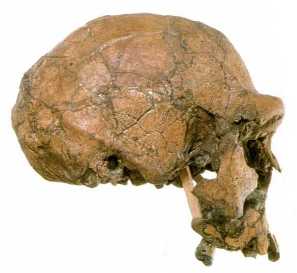
Skull KNM-ER 3733
Legacy route: /faqs/homs/3733.html · Source: faqs/homs/3733.html
Skull KNM-ER 3733
KNM-ER 3733, Homo erectus (or Homo ergaster )
Discovered by Bernard Ngeneo in 1975 at Koobi Fora in Kenya. Estimated
age is 1.7 million years. This superb find consisted of an almost
complete cranium. The brain size is about 850 cc, and the whole skull
is similar to some of the Peking Man fossils. Because the facial features
are less robust than that of the Turkana Boy , this skull is thought to be female.
The brain size of 850 cc is extremely small by modern standards. A very
similar skull, ER 3883, is even smaller, at 800 cc.
Creationist arguments about Homo
erectus
This page is part of the Fossil Hominids FAQ at the talk.origins Archive .
Home Page |
Species |
Fossils |
Creationism |
Reading |
References Illustrations |
What's New |
Feedback |
Search |
Links |
Fiction
http://www.talkorigins.org/faqs/homs/3733.html, 03/31/2001Email me
Workbench Augmentation
The legacy author text above is preserved for review. The sections below are generated review scaffolds for responsive design, citations, related reading, and concept mapping.
Additional Citations
Queued for citation review in the workbench.
Conceptual Connections
Archive FAQ
Fossil evidence
Creationist claims
Human evolution
Critic Walkthroughs
Responsive Design Walkthrough Inspect headings, tables, images, lists, anchors, and sidebars across mobile and desktop widths without altering attributed prose.
Content Structure Walkthrough Identify opportunities for section landmarks, summaries, related-reading placement, and conceptual signposts while preserving the original author text.
Citation Augmentation Walkthrough Find cited sources, stale links, missing bibliographic metadata, and candidates for an Additional Citations section.
Conceptual Connections Walkthrough Map the page to related claims, FAQs, notebook concepts, and search corpus terms.
Legacy Function Walkthrough Check whether the converted page preserves the legacy route, anchors, images, forms, and internal navigation behavior.